Here's the "video" I made of Comet Hartley taken 10-9-10.
Visit TheSkySearchers.com forum. A friendly bunch of amateur astronomers.TheSkySearchers.com 
Sunday, October 10, 2010

Saturday, October 9, 2010
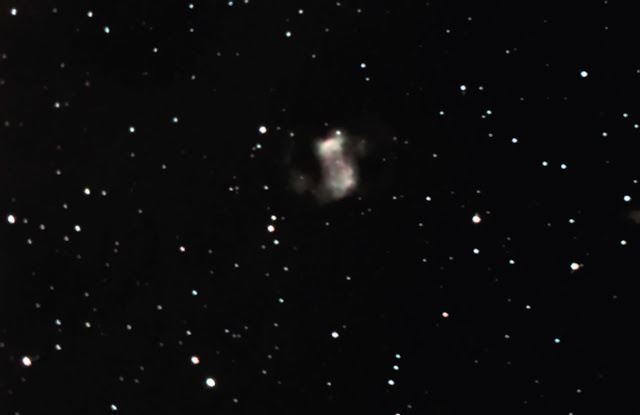
M76 Little Dumbbell
Here's last nights attempt at the Little Dumbbell. 60 each 1 minute images guided.
From Wikipedia:
The Little Dumbbell Nebula, also known as Messier 76, NGC 650/651, the Barbell Nebula, or the Cork Nebula [1], is a planetary nebula in the constellation Perseus. It was discovered by Pierre Méchain in 1780 and included in Charles Messier's catalog of comet-like objects as number 76. It was first recognised as a planetary nebula in 1918 by the astronomer Heber Doust Curtis. However, there is some contention to this claim, as Isaac Roberts in 1891 did suggest that M76 might be similar to the Ring Nebula (M57), being instead as seen from the side view. [2] The structure is now classed as a bipolar planetary nebula (BPNe).[3]
Distance to M76 is currently estimated as 780 parsecs or 2,500 light years [4], making the average dimensions about 0.378 pc. (1.23 ly.) across. [5]
The total nebula shines at the apparent magnitude of +10.1 with its central star or planetary nebula nucleus (PNN) at +15.9v (16.1B) magnitude.[1] The UV-light from the PNN is expanding outer layers that form the present nebula, and has the surface temperature of about 88,400 K. The whole planetary nebula is approaching us at −19.1km.s-1. [6]
The Little Dumbbell Nebula derives its common name from its resemblance to the Dumbbell Nebula (M27) in Vulpecula. It was originally thought to consist of two separate emission nebulae and was thus given two catalog numbers in the NGC 650 and 651. Some consider this object the faintest and hardest to see objects in Messier's list.

From Wikipedia:
The Little Dumbbell Nebula, also known as Messier 76, NGC 650/651, the Barbell Nebula, or the Cork Nebula [1], is a planetary nebula in the constellation Perseus. It was discovered by Pierre Méchain in 1780 and included in Charles Messier's catalog of comet-like objects as number 76. It was first recognised as a planetary nebula in 1918 by the astronomer Heber Doust Curtis. However, there is some contention to this claim, as Isaac Roberts in 1891 did suggest that M76 might be similar to the Ring Nebula (M57), being instead as seen from the side view. [2] The structure is now classed as a bipolar planetary nebula (BPNe).[3]
Distance to M76 is currently estimated as 780 parsecs or 2,500 light years [4], making the average dimensions about 0.378 pc. (1.23 ly.) across. [5]
The total nebula shines at the apparent magnitude of +10.1 with its central star or planetary nebula nucleus (PNN) at +15.9v (16.1B) magnitude.[1] The UV-light from the PNN is expanding outer layers that form the present nebula, and has the surface temperature of about 88,400 K. The whole planetary nebula is approaching us at −19.1km.s-1. [6]
The Little Dumbbell Nebula derives its common name from its resemblance to the Dumbbell Nebula (M27) in Vulpecula. It was originally thought to consist of two separate emission nebulae and was thus given two catalog numbers in the NGC 650 and 651. Some consider this object the faintest and hardest to see objects in Messier's list.
Sunday, September 26, 2010
M110 galaxy
Here's a 28 x 1 minute image of the M110 galaxy. Moon was almost full so it wiped out much of the detail.


Saturday, September 25, 2010
Comet P/103 Hartley 2 Video
Thought I would give this a shot. I took 16 images of the Hartley 2 comet tonight and made them into a video so you can detect the movement of the comet against the stars.
Sunday, September 19, 2010


Sunday, August 15, 2010
M20 Trifid Nebula with great guiding!
I've been busy getting the settings worked out in PHD since I changed from the 70mm guide scope to the 9x50 viewfinder setup.
I finally got it nailed down last night. I was able to catch a 10 minute single exposure guided with no star trails and nice round stars! (It's only taken a year to get the bugs worked out!)
The "test exposure" was of just a star field so nothing to really see.
I did manage to capture 3 each 2 minute images of M20 however. I would have taken more but I realized I was getting very close to the meridian and didn't want to take a chance of the scope doing a "flip".
Look at the little pin point stars...... I have never been able to get that precise of image before! I think I've finally got the bugs worked out!

I finally got it nailed down last night. I was able to catch a 10 minute single exposure guided with no star trails and nice round stars! (It's only taken a year to get the bugs worked out!)
The "test exposure" was of just a star field so nothing to really see.
I did manage to capture 3 each 2 minute images of M20 however. I would have taken more but I realized I was getting very close to the meridian and didn't want to take a chance of the scope doing a "flip".
Look at the little pin point stars...... I have never been able to get that precise of image before! I think I've finally got the bugs worked out!

Subscribe to:
Posts (Atom)