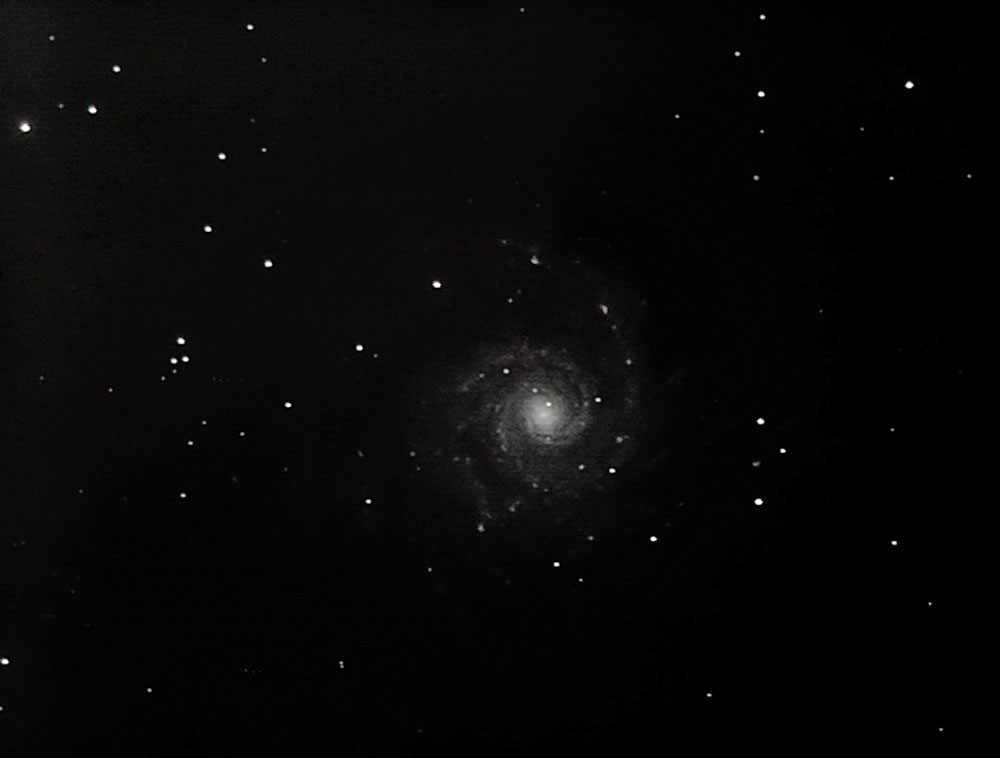
Keeping in mind this is a first attempt and I was trying for a very dim object that is hard to capture with an un-modified DSLR.
If you look very closely in the upper middle of this photo you can just make out the horse head nebula. This is 15 each 30 second images so it was probably not the best first light object.
DSLR imaging is gonna be fun!
Visit TheSkySearchers.com forum. A friendly bunch of amateur astronomers.TheSkySearchers.com
www.webewebbiers.com/Astronomy.htm
Saturday, January 22, 2011
Wednesday, January 12, 2011
This years Crab Nebula (M1)
I had about 1/2 moon tonight and it was very close to M1 so it cast some "tube shadows" in the image. Tonight was more for doing some testing and getting set up for my new (used) DSLR camera. Should be here next week and if the sky's hold I will be ready to really do some new work.
In the mean time here's the Crab: 37 images 30 second long stacked.
Monday, December 13, 2010
The Horsehead Nebula
I was playing with setting up the periodic error files on the telescope mount last night and just for the heck if it I pointed the scope towards the horsehead nebula in Orion. I have read this is a very hard object to image as it is basically a "backlit" nebula from a nearby star. Since I couldn't see any sign of the nebula in a 1 minute preview I just took a chance and shot 15 each 1 minute images. Imagine my surprise when I started to process the stacked image! There it was, just as I would have framed it in the photo! I'm hoping to try to get more data to add to it. But all things considered I'm really happy with what I got!
From Wikipedia:
The Horsehead Nebula (also known as Barnard 33 in bright nebula IC 434) is a dark nebula in the constellation Orion. The nebula is located just to the south of the star Alnitak, which is furthest east on Orion's Belt, and is part of the much larger Orion Molecular Cloud Complex. The Horsehead Nebula is approximately 1500 light years from Earth. It is one of the most identifiable nebulae because of the shape of its swirling cloud of dark dust and gases, which is similar to that of a horse's head when viewed from Earth. The shape was first noticed in 1888 by Williamina Fleming on photographic plate B2312 taken at the Harvard College Observatory.
The red glow originates from hydrogen gas predominantly behind the nebula, ionized by the nearby bright star Sigma Orionis. The darkness of the Horsehead is caused mostly by thick dust, although the lower part of the Horsehead's neck casts a shadow to the left. Streams of gas leaving the nebula are funneled by a strong magnetic field. Bright spots in the Horsehead Nebula's base are young stars just in the process of forming.
From Wikipedia:
The Horsehead Nebula (also known as Barnard 33 in bright nebula IC 434) is a dark nebula in the constellation Orion. The nebula is located just to the south of the star Alnitak, which is furthest east on Orion's Belt, and is part of the much larger Orion Molecular Cloud Complex. The Horsehead Nebula is approximately 1500 light years from Earth. It is one of the most identifiable nebulae because of the shape of its swirling cloud of dark dust and gases, which is similar to that of a horse's head when viewed from Earth. The shape was first noticed in 1888 by Williamina Fleming on photographic plate B2312 taken at the Harvard College Observatory.
The red glow originates from hydrogen gas predominantly behind the nebula, ionized by the nearby bright star Sigma Orionis. The darkness of the Horsehead is caused mostly by thick dust, although the lower part of the Horsehead's neck casts a shadow to the left. Streams of gas leaving the nebula are funneled by a strong magnetic field. Bright spots in the Horsehead Nebula's base are young stars just in the process of forming.
Friday, November 26, 2010
NGC246 The Skull Nebula
Here's a "scary one!"
30 each 90 second images.
From Wikipedia:
NGC 246 (sometimes called the Skull Nebula[2]) is a planetary nebula in the constellation Cetus.
30 each 90 second images.
From Wikipedia:
NGC 246 (sometimes called the Skull Nebula[2]) is a planetary nebula in the constellation Cetus.
Wednesday, November 10, 2010
M74
M74 galaxy, 30 images @ 2 minutes each guided.
From Wikipedia:
Messier 74 (also known as NGC 628) is a face-on spiral galaxy in the constellation Pisces. The galaxy contains two clearly-defined spiral arms and is therefore used as an archetypal example of a Grand Design Spiral Galaxy.[4] The galaxy's low surface brightness makes it the most difficult Messier object for amateur astronomers to observe.[5][6] However, the relatively large angular size of the galaxy and the galaxy's face-on orientation make it an ideal object for professional astronomers who want to study spiral arm structure and spiral density waves.
M74 was discovered by Pierre Méchain in 1780. Méchain then communicated his discovery to Charles Messier, who listed the galaxy in his catalog.[6]
From Wikipedia:
Messier 74 (also known as NGC 628) is a face-on spiral galaxy in the constellation Pisces. The galaxy contains two clearly-defined spiral arms and is therefore used as an archetypal example of a Grand Design Spiral Galaxy.[4] The galaxy's low surface brightness makes it the most difficult Messier object for amateur astronomers to observe.[5][6] However, the relatively large angular size of the galaxy and the galaxy's face-on orientation make it an ideal object for professional astronomers who want to study spiral arm structure and spiral density waves.
M74 was discovered by Pierre Méchain in 1780. Méchain then communicated his discovery to Charles Messier, who listed the galaxy in his catalog.[6]
Friday, October 29, 2010
M33-Triangulum Galaxy
25 each 3 minute images. (no discards!) The image also includes one 5 minute image. I switched over from ST-4 guiding to pulseguiding. Man what a difference! Anyway here are the results.
Wednesday, October 13, 2010
NGC7662 Blue Snowball
I finally got my polar alignment dialed in now. So gave this a shot.
From Wikipedia:
NGC 7662 otherwise known as the Blue Snowball Nebula is a planetary nebula located in the constellation Andromeda.
The distance to this nebula is not known with any real accuracy. According to the Skalnate Pleso Catalogue (1951) the distance of NGC 7662 is about 1,800 light years, the actual diameter about 20,000 AU. In a more recent survey of the brighter planetaries, C.R.O'Dell (1963) derived a distance of 1,740 parsecs or about 5,600 light years, increasing the actual size to 0.8 light year, or nearly 50,000 AU. It has a faint central star that is variable, with a magnitude range of 12 to 16.[3] The central star is a bluish dwarf with a continuous spectrum and a computed temperature of about 75,000K. The nuclei of the planetary nebulae are among the hottest stars known.[4]
NGC 7662 is a fairly popular planetary nebula for casual observers. A small refractor will reveal a star-like object with slight nebulosity. A 6 in. telescope with a magnification around 100x will reveal a slightly bluish disk. Telescopes of diameter 16" or greater may reveal slight color and brightness variations in the interior.
From Wikipedia:
NGC 7662 otherwise known as the Blue Snowball Nebula is a planetary nebula located in the constellation Andromeda.
The distance to this nebula is not known with any real accuracy. According to the Skalnate Pleso Catalogue (1951) the distance of NGC 7662 is about 1,800 light years, the actual diameter about 20,000 AU. In a more recent survey of the brighter planetaries, C.R.O'Dell (1963) derived a distance of 1,740 parsecs or about 5,600 light years, increasing the actual size to 0.8 light year, or nearly 50,000 AU. It has a faint central star that is variable, with a magnitude range of 12 to 16.[3] The central star is a bluish dwarf with a continuous spectrum and a computed temperature of about 75,000K. The nuclei of the planetary nebulae are among the hottest stars known.[4]
NGC 7662 is a fairly popular planetary nebula for casual observers. A small refractor will reveal a star-like object with slight nebulosity. A 6 in. telescope with a magnification around 100x will reveal a slightly bluish disk. Telescopes of diameter 16" or greater may reveal slight color and brightness variations in the interior.
Subscribe to:
Posts (Atom)