
Visit TheSkySearchers.com forum. A friendly bunch of amateur astronomers.TheSkySearchers.com 
Saturday, April 16, 2011
Almost full moon!
Decided to try using the Canon XT to capture the moon. Came out pretty good considering I didn't spend much time focusing.


Friday, April 1, 2011
M99 and M100 galaxies
This time of year the galaxies are abundant in our skies. I picked a couple out last night that are close together and fit the DSI IIc image chip size well.
Here are the results: 15 or so 90 second images.
M99


Here are the results: 15 or so 90 second images.
M99

M100


Friday, March 11, 2011
M106
Gave capturing M106 a shot last night. 21 each 4 minute images:

From Wikipedia:
Messier 106 (also known as NGC 4258) is a spiral galaxy in the constellation Canes Venatici. It was discovered by Pierre Méchain in 1781. M106 is at a distance of about 22 to 25 million light-years away from Earth. It is also a Seyfert II galaxy, which means that due to x-rays and unusual emission lines detected, it is suspected that part of the galaxy is falling into a supermassive black hole in the center.[7] NGC 4217 is a possible companion galaxy of Messier 106.[6]


From Wikipedia:
Messier 106 (also known as NGC 4258) is a spiral galaxy in the constellation Canes Venatici. It was discovered by Pierre Méchain in 1781. M106 is at a distance of about 22 to 25 million light-years away from Earth. It is also a Seyfert II galaxy, which means that due to x-rays and unusual emission lines detected, it is suspected that part of the galaxy is falling into a supermassive black hole in the center.[7] NGC 4217 is a possible companion galaxy of Messier 106.[6]
Thursday, March 10, 2011
M97 The Owl nebula
I'm still going through the learning curve. However I was able to get some great guiding last night and tried changing my ISO to 1600. I found this worked great and took 30 each 2 min images. Captured and pre-processed in Nebulosity, final process in PS elements.
SW 254N / EQ5pro / Canon 350d / guided image binned 2x2.

M97 is regarded as one of the more complex of the planetaries. The 16th magnitude central star has about 0.7 solar mass and the nebula itself about 0.15 solar mass. The nebula formed roughly 6,000 years ago.
The nebula gets it name due to the appearance of owl-like "eyes" when view through a large (>200 mm) telescope under dark sky conditions with the aid of a so-called "nebula filter." The "eyes" are also easily visible through photographs taken of the nebula.
SW 254N / EQ5pro / Canon 350d / guided image binned 2x2.

From Wikipedia:
The Owl Nebula (also known as Messier Object 97 or NGC 3587) is a planetary nebula in the constellation Ursa Major. It was discovered by Pierre Méchain in 1781.M97 is regarded as one of the more complex of the planetaries. The 16th magnitude central star has about 0.7 solar mass and the nebula itself about 0.15 solar mass. The nebula formed roughly 6,000 years ago.
The nebula gets it name due to the appearance of owl-like "eyes" when view through a large (>200 mm) telescope under dark sky conditions with the aid of a so-called "nebula filter." The "eyes" are also easily visible through photographs taken of the nebula.
Saturday, March 5, 2011
M95 galaxy
Trying out some different techniques with the DSLR. This is my first attempt using 'flats'. It seemed to work pretty well.
from Wikipedia:
Messier 95 (also known as M95 or NGC 3351) is a barred spiral galaxy about 38 million light-years away in the constellation Leo. It was discovered by Pierre Méchain in 1781, and catalogued by Charles Messier four days later.

from Wikipedia:
Messier 95 (also known as M95 or NGC 3351) is a barred spiral galaxy about 38 million light-years away in the constellation Leo. It was discovered by Pierre Méchain in 1781, and catalogued by Charles Messier four days later.

Monday, February 14, 2011
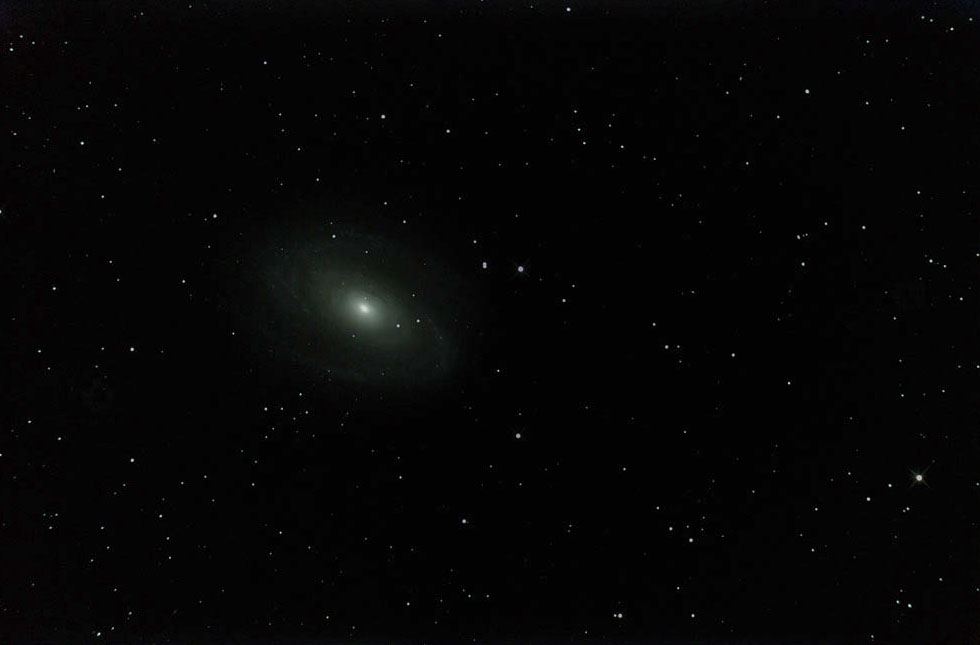
M81 Bodes Galaxy
I've been playing with the 'new' Canon XT. I'm starting to get the hang of processing now. I tried some 5 minute exposures the other night and got 7 of them to come out pretty good. (out of 12 taken). These were processed using bias and bad pixel mapping. Since I'm still working on getting my flats taken I just used a "false flat" layer in PS elements and subtracted it so I could remove the vignetting that I have using the DSLR. Anyway I'm pretty happy with the results.


Tuesday, February 8, 2011
Super Nova SN1120b
I thought I would give this a try as it's not going to be visible for much longer.
14 each 120 second images at ISO800.

14 each 120 second images at ISO800.

Subscribe to:
Posts (Atom)