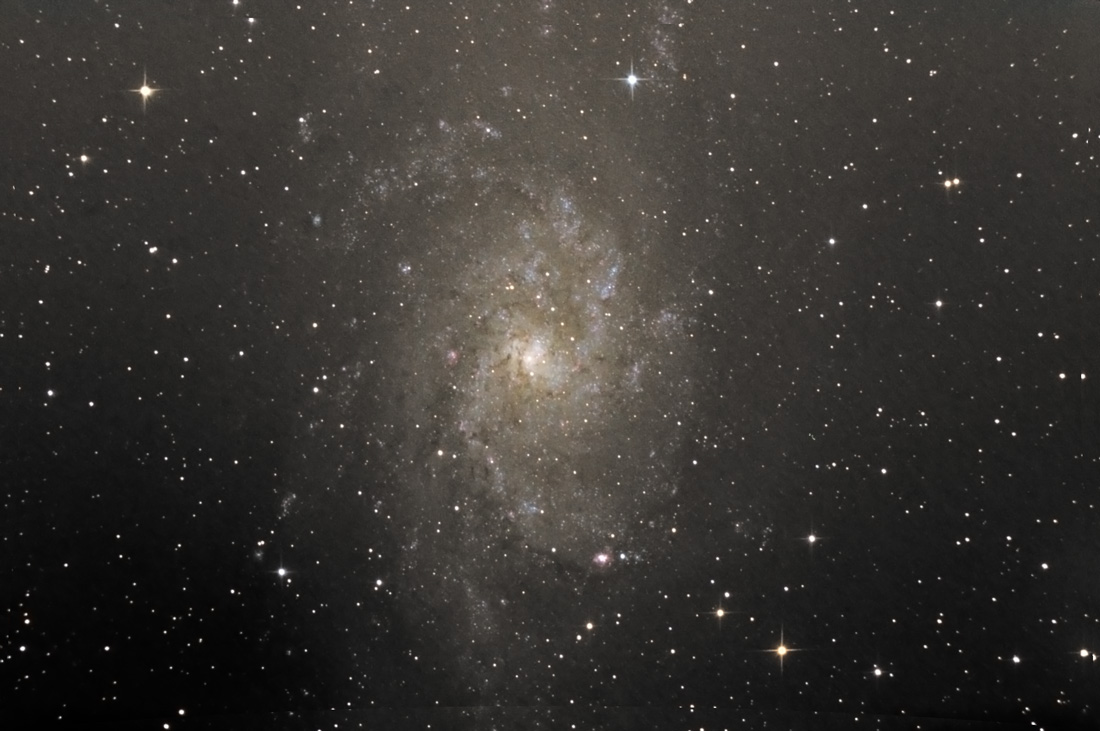
Took this shot with the DSLR (Canon 350d modified) the other night. 16X3min guided, SW254N, EQ5p.
from Wikipedia:
The Triangulum Galaxy is a spiral galaxy approximately 3 million light years (ly) from Earth in the constellation Triangulum. It is catalogued as Messier 33 or NGC 598, and is sometimes informally referred to as the Pinwheel Galaxy, a nickname it shares with Messier 101. The Triangulum Galaxy is the third-largest member of the Local Group of galaxies, which includes the Milky Way Galaxy, the Andromeda Galaxy and about 30 other smaller galaxies. It is one of the most distant permanent objects that can be viewed with the naked eye.
Visit TheSkySearchers.com forum. A friendly bunch of amateur astronomers.TheSkySearchers.com
www.webewebbiers.com/Astronomy.htm
Friday, October 28, 2011
Monday, October 24, 2011
IC1795
IC1795
I've been attempting longer exposures and was able to get great guiding last night, so thought I would try this target. It's very faint so was pretty happy with the results.
20 each 6 minute images ISO800. SW254N, EQ5p, guided, Canon 350d modified.
from Atlas of the Universe:
I've been attempting longer exposures and was able to get great guiding last night, so thought I would try this target. It's very faint so was pretty happy with the results.
20 each 6 minute images ISO800. SW254N, EQ5p, guided, Canon 350d modified.
from Atlas of the Universe:
The Nebulae associated with the Heart and Soul Nebulae
IC 1795 is a bright nebula attached to the right side of IC 1805. NGC 896 simply seems to refer to the brightest part of IC 1795.Monday, October 17, 2011
M32
I've been on a 'messier marathon' of sorts lately. Lots of short (30 second) exposures to capture as many Messier objects as I can. (up to 50 now!) Anyway, one of the ones I shot the other night came out kinda neat. I took 3 minute images of this one to try to overwhelm the Andromeda galaxy as M32 is on the edge of M31 (Andromeda). Here are the results.
Wednesday, September 28, 2011
Sunday, September 4, 2011
Bubble Nebula
I was able to get some really great guiding working last night! I have taken images of the Bubble nebula last year with the DSI IIc. so figured I would give it a shot with the modified DSLR. Here's the results:
SW 254N, EQ5 pro, guided, Canon XT (modified) 3 minute images, ISO 1600, 33 minutes total.
From Wikipedia:
NGC 7635, also called the Bubble Nebula, Sharpless 162, or Caldwell 11, is a H II region[2] emission nebula in the constellation Cassiopeia. It lies close to the direction of the open cluster Messier 52. The "bubble" is created by the stellar wind from a massive hot, 8.7[2] magnitude young central star, the 15 ± 5 M☉[4] SAO 20575 (BD+60 2522).[7] The nebula is near a giant molecular cloud which contains the expansion of the bubble nebula while itself being excited by the hot central star, causing it to glow.[7] It was discovered in 1787 by Friedrich Wilhelm Herschel.[6] The star SAO 20575 or BD+602522 is thought to have a mass of 10-40 Solar masses.
SW 254N, EQ5 pro, guided, Canon XT (modified) 3 minute images, ISO 1600, 33 minutes total.
From Wikipedia:
NGC 7635, also called the Bubble Nebula, Sharpless 162, or Caldwell 11, is a H II region[2] emission nebula in the constellation Cassiopeia. It lies close to the direction of the open cluster Messier 52. The "bubble" is created by the stellar wind from a massive hot, 8.7[2] magnitude young central star, the 15 ± 5 M☉[4] SAO 20575 (BD+60 2522).[7] The nebula is near a giant molecular cloud which contains the expansion of the bubble nebula while itself being excited by the hot central star, causing it to glow.[7] It was discovered in 1787 by Friedrich Wilhelm Herschel.[6] The star SAO 20575 or BD+602522 is thought to have a mass of 10-40 Solar masses.
Wednesday, August 31, 2011
Saturday, August 20, 2011
The Pelican Nebula (also known as IC5070 and IC5067)
23 each 2 minute images, ISO800 modified Canon XT, SW254N scope, EQ5pro mount:
From Wikipedia:
The Pelican Nebula (also known as IC5070 and IC5067) is an H II region associated with the North America Nebula in the constellation Cygnus. The nebula resembles a pelican in shape, hence the name. The Pelican Nebula is a large area of emission nebula in the constellation Cygnus (the Swan), close to Deneb, and divided from its brighter, larger neighbor, the North America Nebula, by a molecular cloud filled with dark dust.
The Pelican is much studied because it has a particularly active mix of star formation and evolving gas clouds. The light from young energetic stars is slowly transforming cold gas to hot and causing an ionization front gradually to advance outward. Particularly dense filaments of cold gas are seen to still remain. Millions of years from now this nebula might no longer be known as the Pelican, as the balance and placement of stars and gas will leave something that appears completely different.
From Wikipedia:
The Pelican Nebula (also known as IC5070 and IC5067) is an H II region associated with the North America Nebula in the constellation Cygnus. The nebula resembles a pelican in shape, hence the name. The Pelican Nebula is a large area of emission nebula in the constellation Cygnus (the Swan), close to Deneb, and divided from its brighter, larger neighbor, the North America Nebula, by a molecular cloud filled with dark dust.
The Pelican is much studied because it has a particularly active mix of star formation and evolving gas clouds. The light from young energetic stars is slowly transforming cold gas to hot and causing an ionization front gradually to advance outward. Particularly dense filaments of cold gas are seen to still remain. Millions of years from now this nebula might no longer be known as the Pelican, as the balance and placement of stars and gas will leave something that appears completely different.
Subscribe to:
Posts (Atom)