Wednesday, March 28, 2012

IC410

A faint, dusty rose of the northern sky, emission nebula IC 410 lies about 12,000 light-years away in the constellation Auriga. The cloud of glowing hydrogen gas is over 100 light-years across, sculpted by stellar winds and radiation from embedded open star cluster NGC 1893. Formed in the interstellar cloud a mere 4 million years ago, bright cluster stars are seen just below the prominent dark dust cloud near picture center.

SW254N / EQ-g / Canon 350d (mod) / 21exp 4mins / pre processed in Nebulosity 3, post processed in StarTools V1.2. 

Wednesday, March 21, 2012

The Leo Trio

I was finally able to capture the Leo Trio last night. I used Startools v1.2 to do the post processing and Nebulosity 3 for the pre processing. I'm very happy with the results. 20 exposures, 2 minutes each. SW254N, Atlas EQ6g. Canon 350d (modified) guided.

(from Wikipedia:)
The Leo Triplet (also known as the M66 Group) is a small group of galaxies about 35 million light-years away[5] in the constellation Leo. This galaxy group consists of the spiral galaxies M65, the M66, and the NGC 3628.

Sunday, March 18, 2012

StarTools v1.2

I've been playing with a new image post-processing program that I was introduced to on AstronomyForum.net. It's called StarTools http://startools.org/drupal/ and so far I have found it to be a great, fast to learn and very powerful image processing program. Since it has been raining here most of this week, I have gone back and played with a few of my images just to give it a test drive. (M20 Trifid Nebula)

Tuesday, January 10, 2012

M45 with new Atlas EQ-G mount

My old EQ5 mount died back in November and I finally acquired the new Orion Atlas EQ-G late last week. I spent a few days fabricating a plate to adapt the new mount to my pier and got everything up and running. Last night was my first attempt at using the new mount for imaging. I am very happy with the results! (SW254N, Atlas EQ-g, (guided), Canon xt (modified), 15 x 3 minutes ISO800.

(from Wikipedia):
In astronomy, the Pleiades, or Seven Sisters (Messier object 45 or M45), is an open star cluster containing middle-aged hot B-type stars located in the constellation of Taurus. It is among the nearest star clusters to Earth and is the cluster most obvious to the naked eye in the night sky. Pleiades has several meanings in different cultures and traditions.
The cluster is dominated by hot blue and extremely luminous stars that have formed within the last 100 million years. Dust that forms a faint reflection nebulosity around the brightest stars was thought at first to be left over from the formation of the cluster (hence the alternate name Maia Nebula after the star Maia), but is now known to be an unrelated dust cloud in the interstellar medium that the stars are currently passing through. Astronomers estimate that the cluster will survive for about another 250 million years, after which it will disperse due to gravitational interactions with its galactic neighborhood.


Friday, October 28, 2011

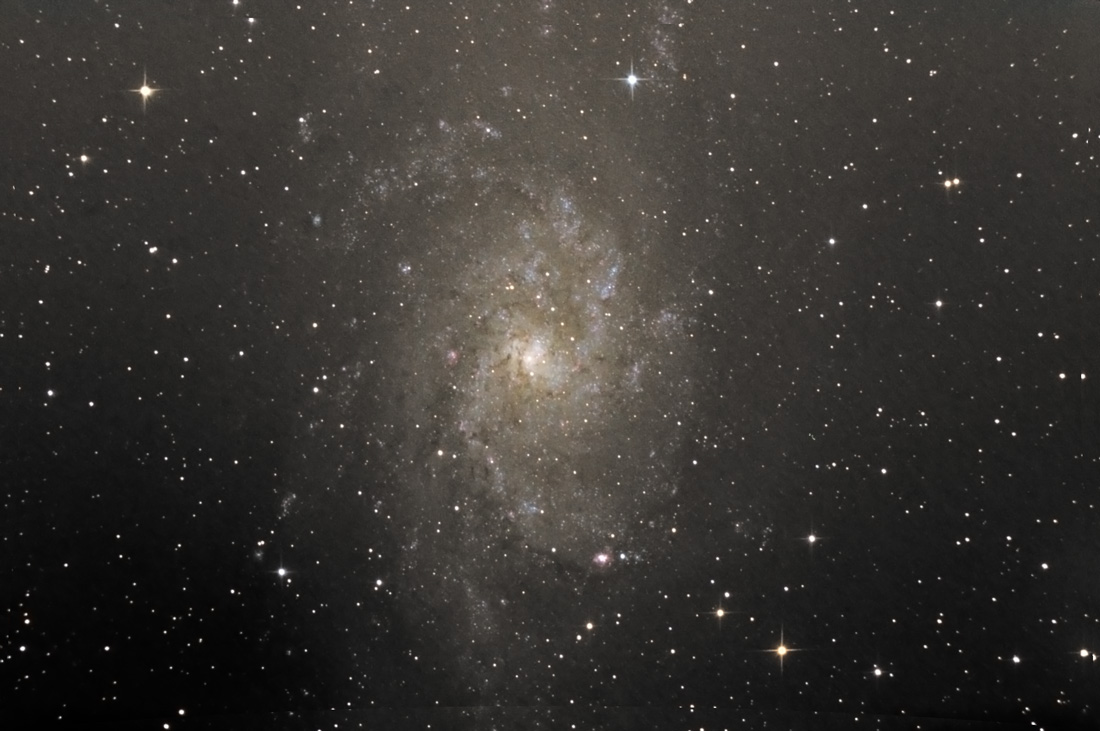
M33 Triangulum Galaxy

Took this shot with the DSLR (Canon 350d modified) the other night. 16X3min guided, SW254N, EQ5p.

from Wikipedia:
The Triangulum Galaxy is a spiral galaxy approximately 3 million light years (ly) from Earth in the constellation Triangulum. It is catalogued as Messier 33 or NGC 598, and is sometimes informally referred to as the Pinwheel Galaxy, a nickname it shares with Messier 101. The Triangulum Galaxy is the third-largest member of the Local Group of galaxies, which includes the Milky Way Galaxy, the Andromeda Galaxy and about 30 other smaller galaxies. It is one of the most distant permanent objects that can be viewed with the naked eye.

Monday, October 24, 2011

IC1795

IC1795
I've been attempting longer exposures and was able to get great guiding last night, so thought I would try this target. It's very faint so was pretty happy with the results.

20 each 6 minute images ISO800. SW254N, EQ5p, guided, Canon 350d modified.

from Atlas of the Universe:


The Nebulae associated with the Heart and Soul Nebulae

IC 1795 is a bright nebula attached to the right side of IC 1805. NGC 896 simply seems to refer to the brightest part of IC 1795.


Monday, October 17, 2011

M32

I've been on a 'messier marathon' of sorts lately. Lots of short (30 second) exposures to capture as many Messier objects as I can. (up to 50 now!) Anyway, one of the ones I shot the other night came out kinda neat. I took 3 minute images of this one to try to overwhelm the Andromeda galaxy as M32 is on the edge of M31 (Andromeda). Here are the results.